ZENITHRA / TRACKER · ENGINEERING HANDOFF
PCB G · Mechanical H · Harness H1 · Fixture G
Engineering prototype. Production is on hold. No physical unit, fixture, manufacturing process or commercial rating has been qualified by these digital checks.
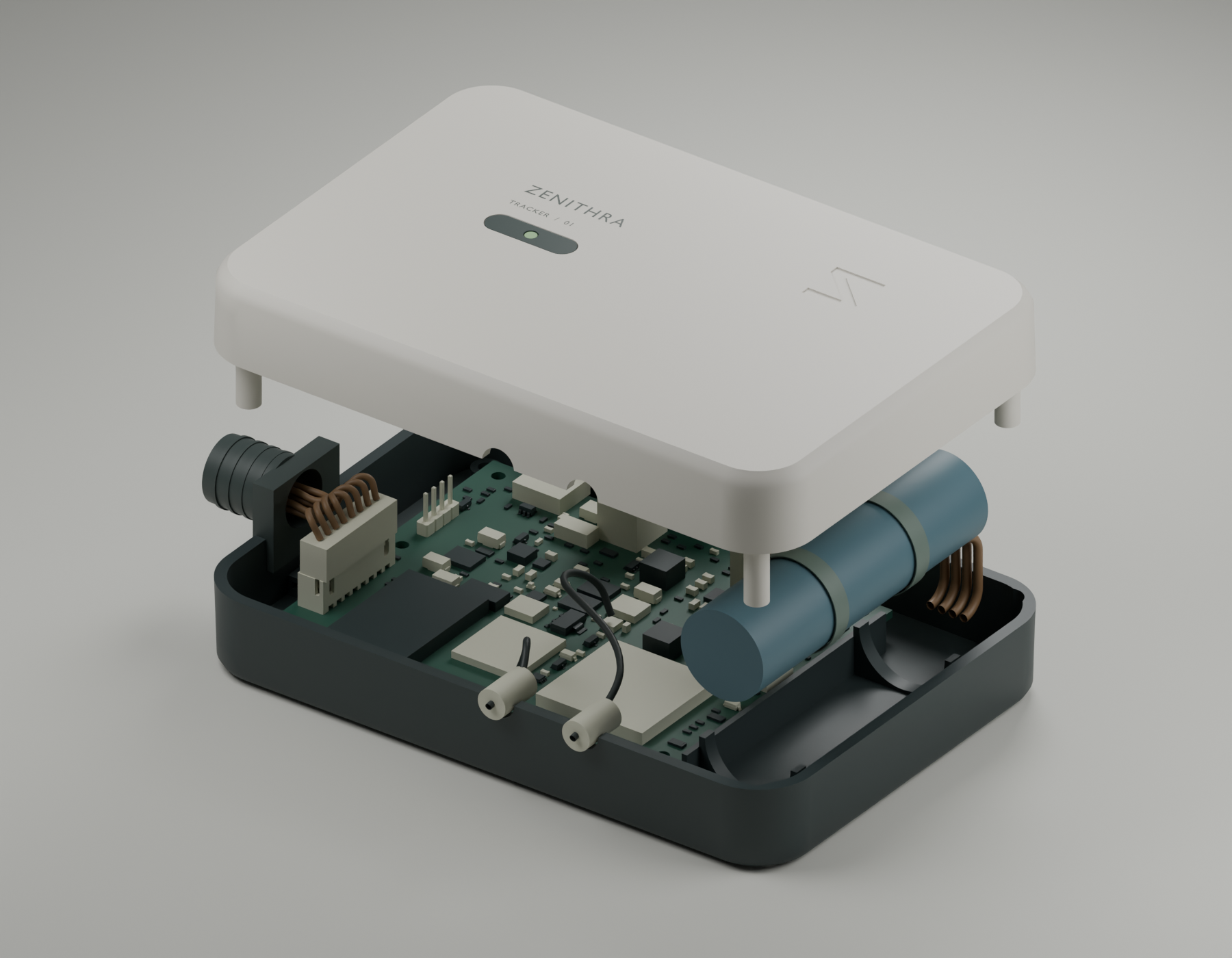
Four-layer PCB/assembly files, native enclosure CAD and STEP/STL, material-specific inserts, connector wire list and machined fixture geometry. PA12 first articles precede molding DFM and tooling.
Independent PCB mounts, underside case screws, separated power and field entries, side battery bay and external RF connections. A sequential traveler controls polarity, calibration, retention and unique firmware.
Full-product configuration hashes connect electronics, firmware source, enclosure, harness, fixtures and process instructions. Signed per-device images and raw instrument evidence are checked separately.
The selected JST VH contact needs at least 1.7 mm wire insulation diameter. The battery CAD now checks 1.8 mm, separates all four routes and uses tangent-continuous bends with a minimum modeled radius of 4.465 mm. Actual wire material and bend suitability require supplier approval. Cut lengths include 8 mm of terminal allowance and are rounded up to 5 mm, subject to first-article verification.
| J4 cavity | Signal | Cut length |
|---|---|---|
| 1 | BAT_RAW | 120 mm |
| 2 | GND | 105 mm |
| 3 | BAT_NTC | 95 mm |
| 4 | PACK_ID | 80 mm |
Electrical cavity mapping is unchanged. Pack-tail order is reversed spatially so the wires can turn without crossing. The pack still needs an insulated cell-bonded 10k B3950 ±1% NTC and a separate pack-end ID resistor.
Host software rejects missing, stale, nonfinite, altered or incomplete records. It does not make instrument measurements, prove review authenticity or grant production release.
Exact pack/wire, strap closure, fastener/pilot/torque, optical retention, cable/antenna interfaces, probe selection and mold DFM need supplier engineering. The 33 acceptance criteria also require electrical/thermal/RF/mechanical qualification, software stress on real hardware, fixture repeatability, pilot yield, complete sourcing/cost and approved customer/shipping information.
No ingress, automotive, measured runtime, certified accuracy or complete-product price is claimed. USB alone is not an operating power supply; the approved SA prototypes omit B40/B41. The user-programmable service SKU does not claim secure boot or flash confidentiality.
Download the mechanical prototype pack · Native geometry checks · Independent export checks · Materials and cost review